Garage Doors
Practical advice
Think of this as the owner's manual the door never came with. Each guide takes one topic, explains it without jargon, and tells you what to watch for as the seasons change.
What people ask us
My door is quite old. Is an inspection still worthwhile?
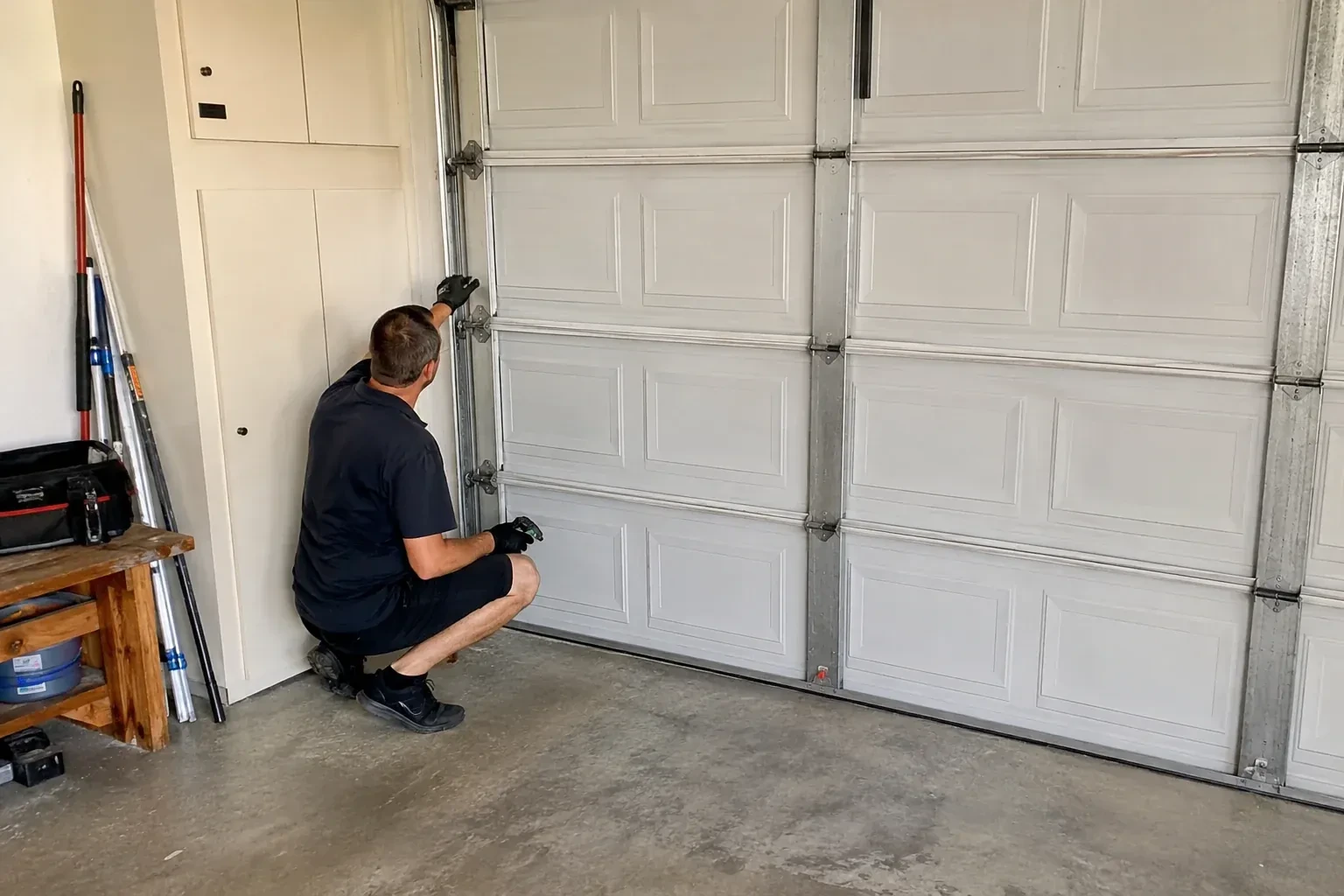
Yes, and often more so. Age alone does not say how much life is left in a spring or a roller, but condition does, and an inspection measures condition. Many older doors are sound and simply need a few worn parts and fresh lubricant. Where the report shows several items coming due at once, you can weigh planned repairs against a new door with real information rather than a guess.
Which lubricant is right for a garage door?
A silicone-based or white lithium garage door lubricant, sold for the purpose. Penetrating oils and general sprays are thin, attract dust and are gone in weeks; heavy grease traps grit. For the rubber bottom seal and weatherstrip, use only a silicone spray, since petroleum products attack rubber and make it brittle. Nylon rollers with sealed bearings need no lubricant, while ones with an exposed bearing can need a touch where their own maker calls for it. A small amount on each point, worked in by moving the door, is enough.
My car is trapped inside. Can I lift the door by hand to get it out?
Lifting a crooked door is where most injuries around this problem happen, because the springs and cables are loaded unevenly and the door can shift suddenly. Tell the technician on the phone that a vehicle is inside; getting it out is part of the plan, and the door will be supported and levelled before it is raised. A short wait is far cheaper than a bent section or a hand caught between panels.
What information or photos help before the visit?
A photograph of the whole door from outside, a close-up of the damaged section, a picture of the manufacturer's label if you can find it, and a shot of the inside of the door showing the hinges, tracks and springs. Add the door's approximate width and height, whether it is insulated, its colour and panel style, and how the damage happened. That set often lets the technician confirm availability before arriving.
What does a new bottom seal do about water coming in?
It closes the gap between the door and the slab so rain and meltwater meet a continuous barrier. Where the driveway slopes toward the garage, or the slab edge has dipped, the seal alone is working against gravity, and a threshold seal glued to the floor adds a lip that turns water back toward the drive. The technician looks at where the water comes from and recommends the combination that suits your threshold.
How should I look after the new seal?
Four times a year, check for daylight from inside with the lights off and press the fin to feel that it is still soft. Wipe the seal with a damp cloth to clear grit and salt, keep paint off the fin, apply a silicone wipe before winter, and keep slush and bins away from the bottom of the jambs. Press any lifted corner back and call if a length has come loose.
How long does a manual lock repair usually take?
An adjustment to a slide bolt or a guide is a short job, while a full T-handle replacement with new bars, a rekey and a door alignment fills a longer visit. Most calls sit somewhere between, and the technician gives you a realistic sense of the time once the door has been looked at, rather than guessing from the phone.
What happens during the visit, and do I need to move the car?
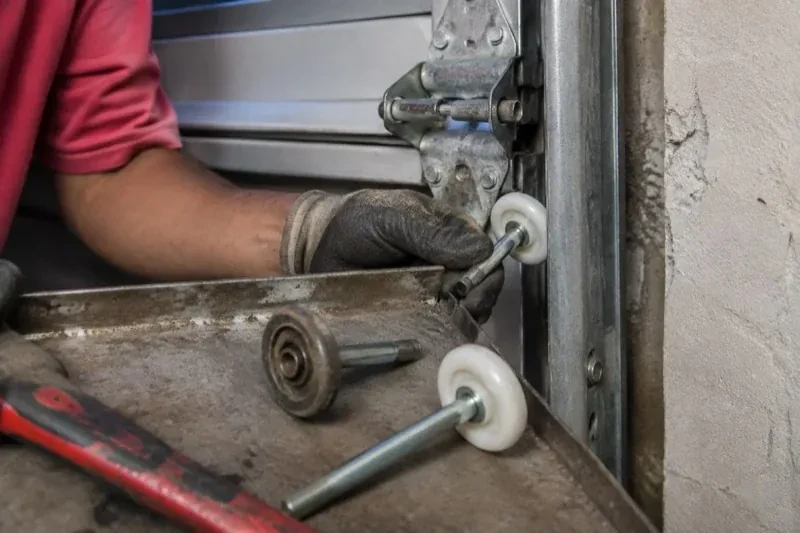
The technician needs clear access to both tracks from floor to ceiling, so moving vehicles out and shifting anything stored against the walls near the tracks helps. The visit itself runs in order: the door is watched in motion, every roller and its hardware is inspected, the door's balance is tested, the door is secured and the rollers are changed one position at a time, the track is cleaned and squared, moving parts are lubricated, and the door and opener are tested.
Are hinges on a wood door different?
The hinges themselves are the same numbered galvanized parts, but the fastening changes. Wood stiles take lag screws or carriage bolts with nuts and washers rather than self-drilling metal screws, and the timber's condition matters as much as the hinge. Softened or split wood around the holes is filled, reinforced or bridged with a backer plate before the hinge goes back on, so the new hardware bites into something solid.
Will track work involve the springs?
Sometimes. The flag bracket at the top of the vertical track usually carries the bearing for the torsion shaft, so if that bracket or the curve has to move, the springs are unloaded first with winding bars and rewound afterwards to the same turns. Simple work on the vertical run below the curve, or on the horizontal hangers, can often be done with the springs left alone. Either way the door is balance-tested at the end.
Should I keep using the opener until the technician arrives?
It is better to leave the door where it is and use another way in and out. Running the opener against a crooked or cable-slack door tends to tangle the cable further, twist the top section and knock the door out of its track, which adds to the repair. Pull nothing and adjust nothing; simply keep the opening clear and let the technician take it from there.
What should I do before the technician arrives?
Keep the door closed and leave it alone, move any vehicle you can reach out of the way or at least clear the space in front of the door inside the garage, and make sure there is room for a ladder beneath the shaft. Note whether there is one spring or two and whether a cable is loose. A photo of the spring area, the drums and the opener helps the technician bring the right parts.
Will the lift cables be changed as well?
They are inspected every time and changed when they show fraying, rust at the bottom loop, or a kink from having jumped a pulley. Cables and springs are generally the same age, and with the door already open and the springs off, fitting new cables adds little to the visit. Bright, tight strands with clean loops can stay and are simply re-routed over the pulleys and set to the new springs.
Why does the door feel heavier in winter?
Cold stiffens the lubricant in the bearings and hinges and firms up the rubber seals, so the door drags a little more and the springs have slightly more to overcome. A bottom seal frozen to the slab adds to it, and this usually eases as temperatures rise. A door that stays heavy is worth a prompt check regardless of season, since persistent drag can come from binding, an obstructed track, rollers, hinges or cables as well as the spring balance.
Which parts most often need replacing on an opener?
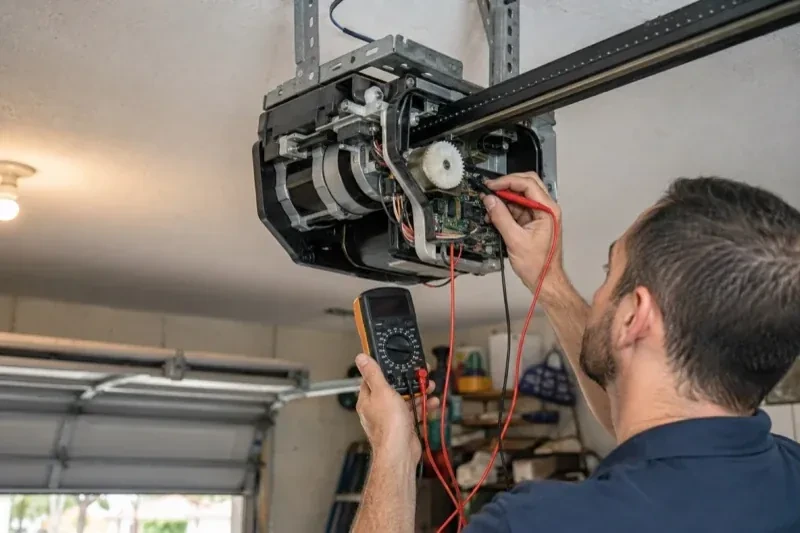
The list is short and familiar: the drive gear and sprocket on chain-drive units, the start capacitor on AC motors, the photo-eye pair and its wire, the trolley and carriage, the wall control, the remotes and their batteries, the light socket, and on newer units the battery backup pack. Logic boards and motors are replaced less often and weighed against the unit's age. Most of the common items are carried to the visit.
Should I use the slide lock on the door with a chain drive?
No. The manual slide lock on the door is disabled or removed once an operator is connected, and the technician checks that during the repair. A motor pulling against a locked door strains the chain, strips the drive gear and can bend the top section of the door. If you want the door secured against remotes, the lock button on the wall control switches them off, and a track lock designed to work with an operator does the rest.
The motor runs but the door stays still. What has happened?
Something between the motor and the door has let go. On a belt drive the usual suspects are a broken clip where the belt joins the trolley, a belt that has jumped off the sprocket or idler pulley, a trolley that failed to re-engage after the red cord was pulled, or a stripped drive gear inside the motor head, which leaves plastic shavings on the housing. Each is a specific repair.
How many remotes and keypads can be added?
Capacity depends on the model: current operators hold anywhere from about eight to forty remote codes, so most households can pair every driver, a keypad, in-car buttons and a phone with room to spare. Remotes are added by holding the learn button on the head unit and pressing the remote; the console guide shows the steps and the technician leaves them written down. If a remote is lost later, clearing the memory and re-teaching the others takes only a few minutes.
Why does it only misbehave on sunny mornings?
Sunlight reaching into the receiving lens can overwhelm the infrared beam from the sending sensor, so for an hour or two the opener acts as if the path is blocked. Garages that face the low sun in winter see it most. The cure is to exchange the two sensors' positions so the receiver no longer looks toward the light, or to fit a small shade over the receiving lens. Once that is done the time of day stops mattering.
What is rolling code and why does it matter for programming?
Most openers made from the mid-1990s on change their code every time a remote is pressed, choosing from billions of possibilities, so a copied code is usually useless next time; the technician confirms the actual system from the model, not age. Programming matters because the opener has to learn each remote's sequence at the learn button; a remote cannot simply be set to match. Older fixed-code openers, set by small switches, can be upgraded with an add-on rolling-code receiver.
What kind of Wi-Fi does it need?
A normal home network with a modern security type and a usable signal at the garage ceiling. Most hubs connect on the 2.4 GHz band, which travels farther through walls than 5 GHz, so a router that broadcasts both is fine as long as the 2.4 GHz network is switched on and can be selected. The technician measures the signal where the hub will sit before mounting anything.
How do I keep the door in manual mode during a long outage?
On many rails, pull the cord straight down and then back toward the opener; the lever stays in the released position until you return it, so the trolley will not catch the door on its own. On others the trolley simply stays free until the opener is run. Lift and lower the door by its handle and use the slide bolt or manual lock to hold it shut. When power returns, reconnect first, then use the wall control.
What maintenance can I do myself?
Keep the door path and seal contact areas clean, visually observe cables and rollers from a safe position, and use designated handles for occasional manual checks. Test operator safety functions as its instructions describe. Adjustments to springs, cables or bottom fixtures remain technician work because those components carry the counterbalance forces.
Can decorative handles and hinges be added?
Decorative hardware can often be included when it is approved for the chosen door and installed in the specified locations. The order records finish, pattern and placement so the exterior remains balanced. Functional lifting hardware is a separate matter and must provide a safe gripping point. Added pieces should not obstruct section joints, tracks, seals or the door's path.
How are springs chosen for the new assembly?
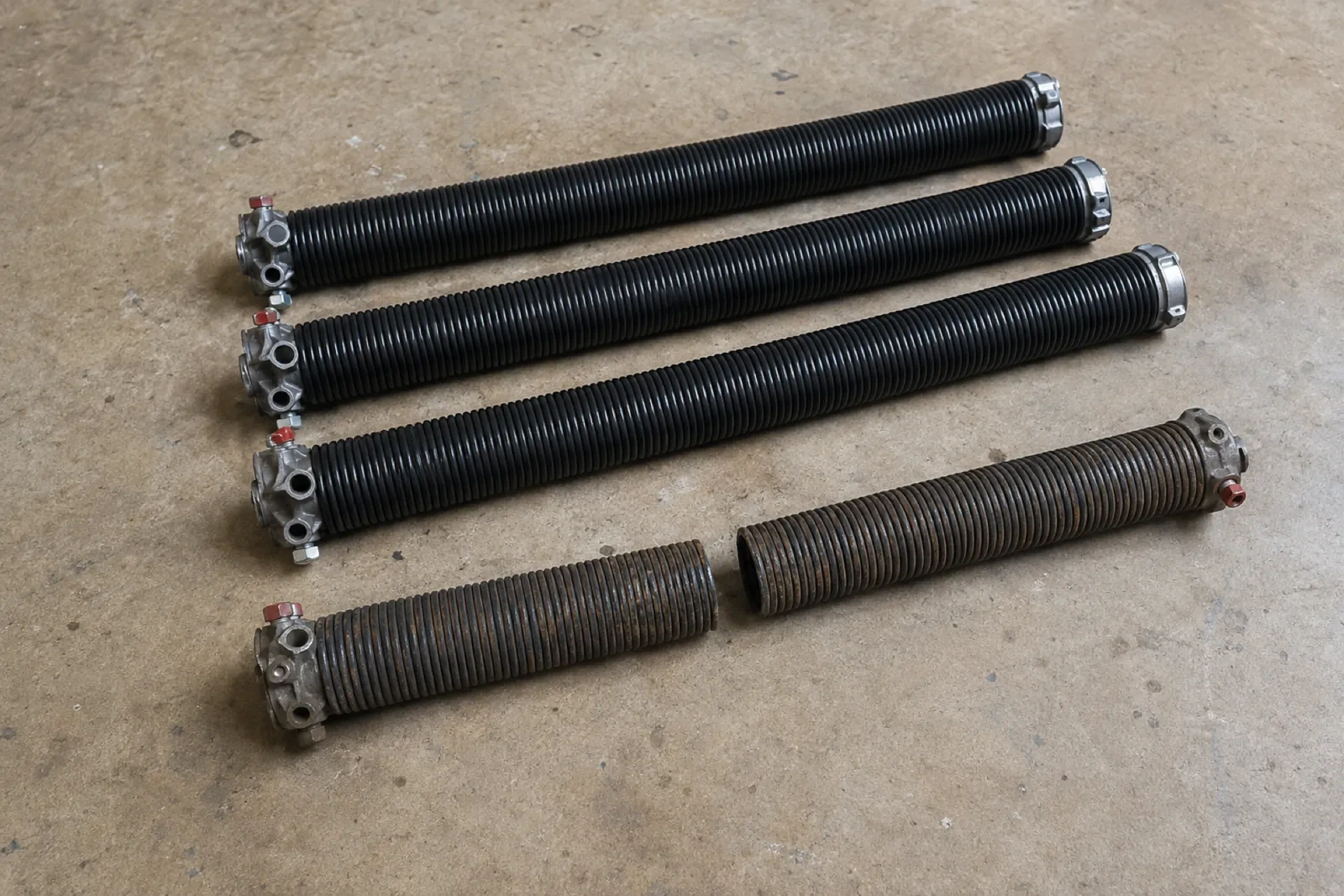
Spring selection uses the completed door's weight, height, lift arrangement, drum geometry, and expected operating cycle. Reinforcement and windows are included in that calculation. After installation, technicians apply tension with proper winding tools and check manual balance through the travel range, adjusting both sides so cables remain even and the door stays controlled.
What measurements are needed before ordering the door?
The survey records clear opening width and height, side room, headroom and backroom, often at more than one point. It also checks floor level, jamb and header condition, ceiling obstacles, track supports and opener position. These measurements determine door size and hardware layout. Exterior trim and the desired panel proportions are documented so technical fit and visual fit agree.
Could permits or structural review be part of the project?
A straightforward replacement in an unchanged opening differs from work that widens the opening, changes the supporting header or forms part of a larger renovation. Commercial settings may add other project requirements. The assessment identifies visible structural and site conditions, while the proposal should state who confirms permit, design and electrical responsibilities that apply to the specific property.
Is an electric operator part of every installation?
No. The door system can be installed and balanced for manual operation, while an electric operator is an additional selected component. When included, the scope should name the operator type, controls, sensors, support and electrical preparation. The door is commissioned by hand before powered travel is set. This sequence confirms that the motor is connected to a freely moving, properly counterbalanced assembly.
How often should commercial door hardware be inspected?
The appropriate interval follows the door and operator manuals, operating cycles, environment and facility maintenance plan. A heavily used exterior bay may need attention more often than a lightly used interior opening. Staff can still observe cables, seals, sensors, sound and travel during normal operation, while tensioned components and adjustments remain part of a technician's planned inspection.
Why is there a grinding or clattering sound near the hood?
Noise at the head can come from worn barrel bearings, loose brackets, misaligned drive chain or sprockets, shifting slats, an uneven coil or hardware contacting the hood. The pattern matters: once per revolution suggests something different from continuous guide scrape. Controlled observation locates the source before a specific part is selected.
What should be moved before the installation visit?
Clear vehicles, shelving contents, loose tools and stored items from the opening, side walls and overhead work zone identified during assessment. Provide access to power controls and the operator. If a vehicle lift is already present, leave it in the agreed position and share its operating dimensions. A tidy bay supports safe equipment placement and accurate alignment work.